Perspectives on Play, Work in Progress, and a workshop on constrained play from CHI Play '26
The Accessibility Paradox
The Accessibility Paradox: Platform Standardisation and the Legitimacy of Play(Burnett, 2026) is a sole-authored Perspectives on Play paper that examines how platform standards can make accessible play possible while also limiting players’ ability to adapt hardware or develop their own solutions; this was based on common participant experiences of other works in progress. I argue that improving accessibility requires us to focus more on who sets the rules for which adaptations are accepted, rather than just the technical work of making games and controllers usable.
Designing with Impaired Technologies
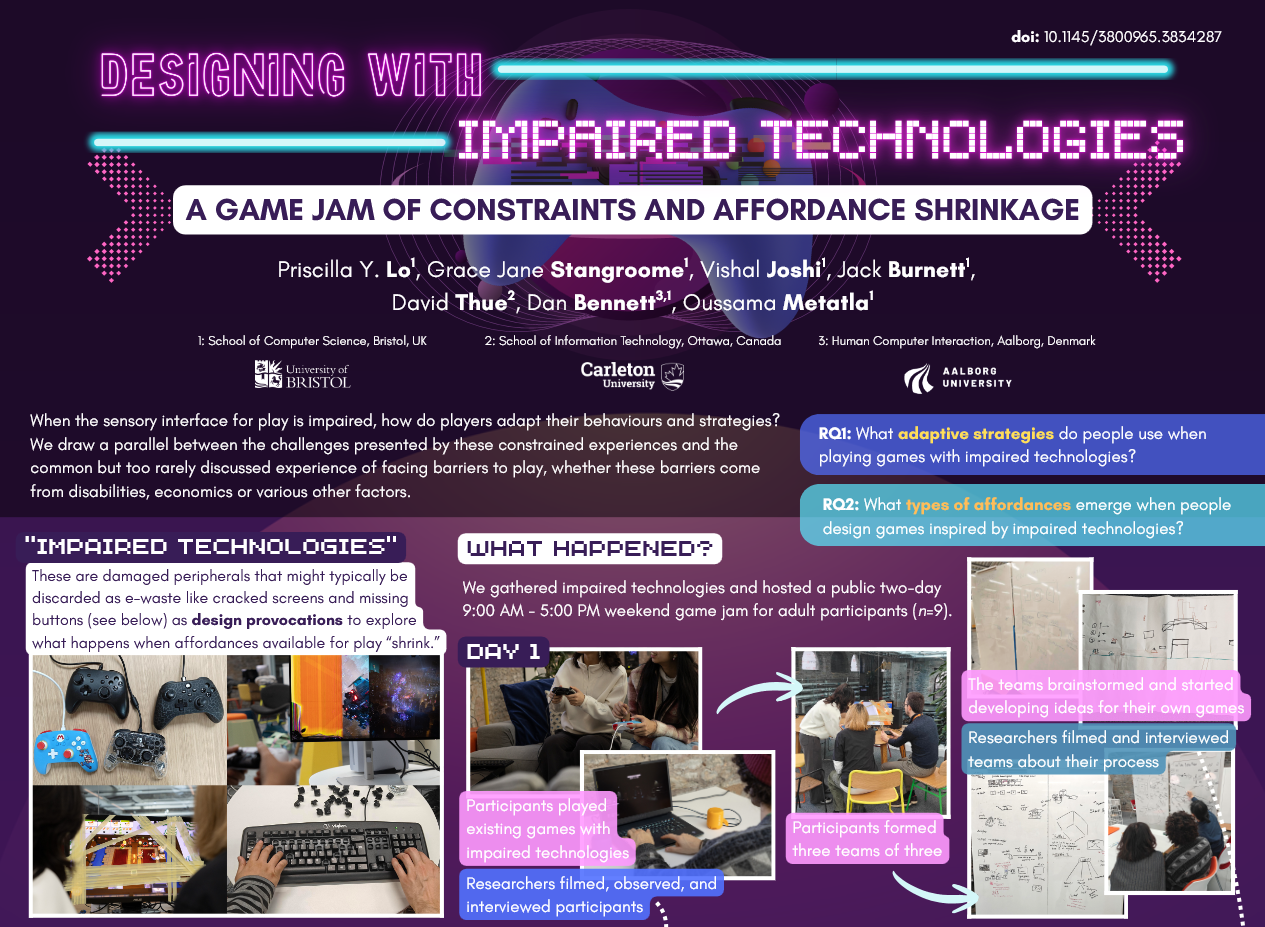
I assisted on Designing with Impaired Technologies: A Game Jam of Constraints and Affordance Shrinkage(Lo et al., 2026), which was presented as a Work in Progress paper. The research used damaged gaming equipment as a design focus point for a two-day public game jam, where participants played existing games before designing their own games in response to hardware constraints. The study explored how players adapt when their available interactions are restricted, and how these adaptations can inspire new game designs. Themes included turning faults into features and building constraints into gameplay.
Playing with Constraints
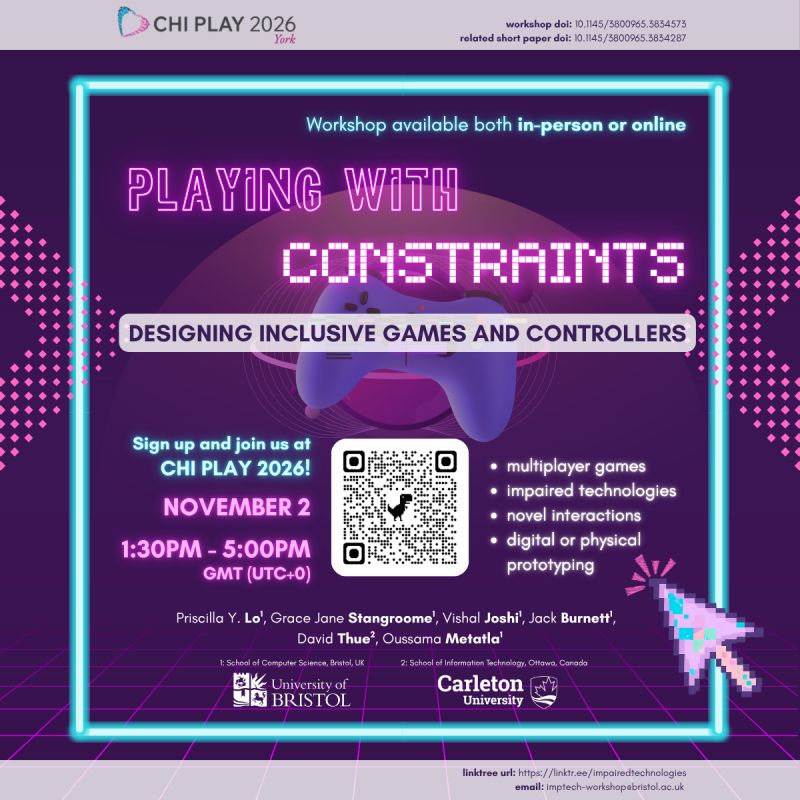
I co-organised Playing with Constraints: Designing Inclusive Games and Controllers(Lo et al., 2026). Building on the impaired technologies research, the workshop explored how constraints could inspire games and controllers for players with different abilities. The activities centred on playing with constrained hardware, to provoke development of multiplayer game concepts or physical prototypes that involve constraints. The workshop connected questions about impaired technology with the design of inclusive play experiences.
Platform standardisation improves accessibility across contemporary gaming ecosystems, but it also shapes which forms of accessible play are recognised as legitimate. This Perspectives on Play paper introduces the accessibility paradox of platform standardisation: the same infrastructures that support accessibility can constrain adaptation and community-led solutions. I argue that accessibility is not solely a technical challenge but also a question of authority, legitimacy, and governance.
@inproceedings{AccessibilityParadox,note={Perspectives on Play},title={The {{Accessibility Paradox}}: {{Platform Standardisation}} and the {{Legitimacy}} of {{Play}}},shorttitle={The {{Accessibility Paradox}}},booktitle={Companion {{Proceedings}} of the {{Annual Symposium}} on {{Computer-Human Interaction}} in {{Play}}},author={Burnett, Jack},year={2026},month=nov,series={{{CHI PLAY Companion}} '26},pages={492--495},publisher={Association for Computing Machinery},address={New York, NY, USA},doi={10.1145/3800965.3834658},urldate={2026-10-27},isbn={979-8-4007-2565-4},keywords={Accessibility,Game Accessibility,Platformisation,Standardisation},}
Playing under constraint, whether due to disability, financial limitations, technological obsolescence, or other factors, is a widespread but under-examined aspect of gaming culture. We introduce “impaired technologies” (damaged peripherals such as cracked screens, controllers with missing buttons, and faulty speakers) as design provocations to explore what happens when the affordances available for play “shrink.” Drawing on Dokumaci’s concepts of “affordance shrinkage” and “activist affordances,” we hosted a two-day public game jam where participants (n=9) first played existing games on impaired technologies, then designed their own games inspired by the experience. We identified six adaptive play strategies improvised under constraint, and three design themes, transforming “bugs” into features, embedding constraint within gameplay, and prioritizing fun over challenge. Our findings position constrained play as a site of creativity and agency, with implications for accessibility, jank, sub-optimal hardware gaming, and inclusive design.
@inproceedings{DesigningImpairedTechnologies,note={Work in Progress},title={Designing with {{Impaired Technologies}}: {{A Game Jam}} of {{Constraints}} and {{Affordance Shrinkage}}},shorttitle={Designing with {{Impaired Technologies}}},booktitle={Companion {{Proceedings}} of the {{Annual Symposium}} on {{Computer-Human Interaction}} in {{Play}}},author={Lo, Priscilla Y. and Stangroome, Grace Jane and Joshi, Vishal and Burnett, Jack and Thue, David and Bennett, Dan and Metatla, Oussama},year={2026},month=nov,series={{{CHI PLAY Companion}} '26},pages={66--73},publisher={Association for Computing Machinery},address={New York, NY, USA},doi={10.1145/3800965.3834287},urldate={2026-10-27},isbn={979-8-4007-2565-4},keywords={accessibility,adaptive,game design,game jam,impairment,inclusion,play styles},}
How can we design inclusive games that appeal to gamers with different abilities? This workshop invites the CHI PLAY community to play with constraints and conceptualize games that enable forms of play beyond conventional patterns. We build on our prior work that applies the concept of “impaired technologies” as a design provocation in a game jam to encourage alternative perspectives on play. Participants will create multiplayer games that are played with impaired technologies or, as an extension, that use novel interactions. We aim to engage researchers and practitioners interested in designing playful prototypes, including digital games, immersive experiences, tangible toys, and game controllers.
@inproceedings{PlayingWithConstraints,note={Workshop Proposal},title={Playing with {{Constraints}}: {{Designing Inclusive Games}} and {{Controllers}}},shorttitle={Playing with {{Constraints}}},booktitle={Companion {{Proceedings}} of the {{Annual Symposium}} on {{Computer-Human Interaction}} in {{Play}}},author={Lo, Priscilla Y. and Stangroome, Grace and Joshi, Vishal and Burnett, Jack and Thue, David and Metatla, Oussama},year={2026},month=nov,series={{{CHI PLAY Companion}} '26},pages={573--575},publisher={Association for Computing Machinery},address={New York, NY, USA},doi={10.1145/3800965.3834573},urldate={2026-10-27},isbn={979-8-4007-2565-4},keywords={accessibility,game jam,inclusion,playful embodiment}}